
Man Next Door
Sixty years of one song

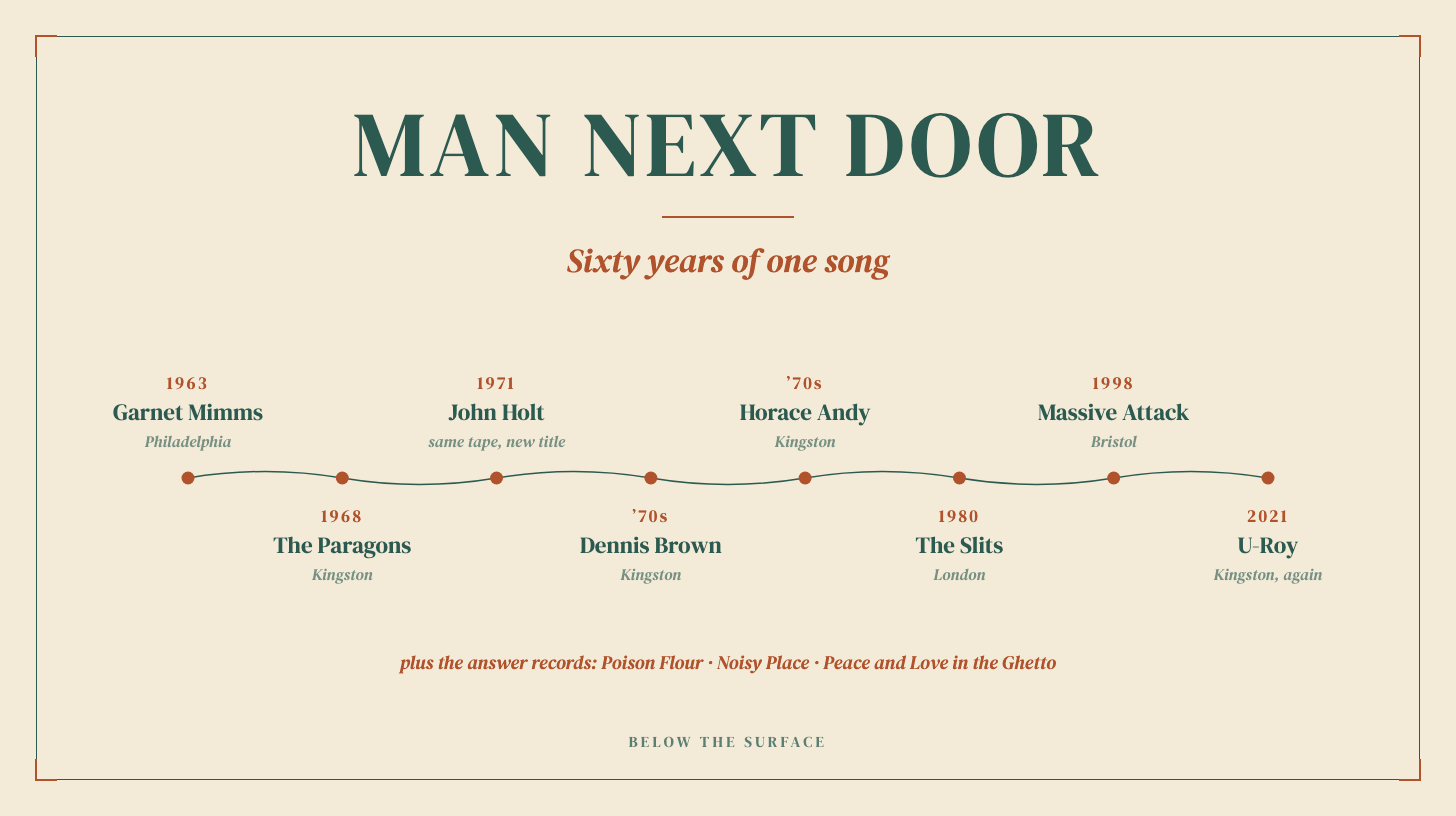
There’s something I save for the right kind of night at One Drop, my monthly session at Bar Gobo. Early in the night, while the room is settling in, I’ll play a rocksteady 45 from 1968: the Paragons, “Man Next Door,” John Holt out front with the harmonies stacked close behind him. It’s a small, domestic song. The neighbours are loud, the walls are thin, I’ve got to get away from here. That’s the whole premise.
A couple of hours later, when the lights feel lower and the room has locked in, I’ll play it again. This time it’s Massive Attack, from Mezzanine, 1998: the same words and the same melody, sung over a drum break lifted from Led Zeppelin, in a mix so paranoid and claustrophobic it feels like the walls aren’t just thin, they’re closing in. Same song. Thirty years and an ocean apart.
When I played at Amber recently I skipped the patience and put them back to back. More on the nose, sure, but that was the idea: no announcement, no explaining, just the same song twice in a row, letting the room feel thirty years go by in the space of a needle drop.
Most times nobody notices, and that’s fine. (The exception was Clint from SpaceLab, the East Hastings shop where vintage speakers share floor space with taxidermy. He clocked it immediately. Sometimes one listener is plenty.) Some records I play for the room. Some I play for that one person who's really listening. The point of the pairing isn't the reveal. The point is the distance travelled, and no song in my crates has travelled further than this one.
A quiet place
Even the original has an original. In 1963 the soul singer Garnet Mimms recorded a ballad called "A Quiet Place," and a few years later in Kingston, John Holt drew on it heavily for the song the Paragons released as "Man Next Door" (sometimes "I've Got to Get Away"). It wasn't even an A-side. It went out tucked on the flip of "Left With a Broken Heart," and nobody involved seems to have guessed what they had.
That origin matters to me, because it’s the first of two currents that run through everything I play. Soul records aren’t a detour from Jamaican music; they’re source texts. Kingston in the sixties was listening hard to American radio, taking what it loved and rebuilding it on its own terms. A song about noisy neighbours, sung beautifully, was always going to make the crossing.
The second current is what happened next.
The version chain
In Jamaica in those years, a song was never really finished. The 45 came with the vocal on one side and the version on the flip: the same rhythm with the singing stripped away, an open invitation for someone else to say something new over it. Producers rebuilt rhythms for new singers. Deejays talked over the instrumentals. A great song wasn’t a monument, it was a premise. The industry ran on this, and “Man Next Door” turned out to be one of the great premises.
The first round of versioning didn’t even involve new music. When Holt went solo, the same recording turned up on his 1971 album Holt under a new title, “Got To Get Away,” with a different producer’s name on it. Dig into who actually cut the original and the paper trail argues with itself; three pressings will give you three answers. That’s version culture too. Before anyone had re-sung a note, the song already had two titles, a contested credit, and a life of its own.
Dennis Brown got to it young, slowing it down and stretching the phrases until the complaint became a lament. Horace Andy cut it in the early seventies and called his version “Quiet Place,” circling the title back toward its soul original, whether he meant to or not. His cut became a rhythm in its own right: Dr Alimantado rode it for “Poison Flour,” and I-Roy answered the title directly with “Noisy Place,” which is the version chain at its most playful. Quiet place, noisy place. The song was having a conversation with itself, in public, on 45.
Then it left the island. In 1980 the Slits, London’s great post-punk band, cut “Man Next Door” as a single. They didn’t punk it up. They brought in Dennis Bovell to produce, the same man behind Janet Kay’s lovers rock hits and Linton Kwesi Johnson’s dub poetry albums, and played it more or less straight, which tells you something about the strength of the bones. It spent thirteen weeks on the UK indie chart. A Jamaican tenement-yard complaint, at home in squat-era London.
And in 1998 Massive Attack made the move that turns this from a good story into a perfect one. Building their version for Mezzanine, they didn’t just cover the song. They flew in the man himself. Horace Andy, twenty-five years after his own “Quiet Place,” sang it again for Bristol, over John Bonham’s drums from “When the Levee Breaks” and a buried sample of the Cure. He’s the only person standing at both ends of the chain. He didn’t cover the song. He travelled with it.
There’s even a coda, two of them. In 2017 Pama International, a British band that named itself after one of the great old reggae labels, cut the song with Anna Uhuru’s voice out front: version culture eating its own tail. And in 2021, on his final album, U-Roy cut it one more time with Santigold, roughly fifty years after he first rode the rhythm. The song outlived almost everyone who touched it, and it was still taking new voices.
Moving house
Here’s the thing I keep turning over. This is a song about wanting to get away from the neighbours, and its whole life story is sixty years of moving into new neighbourhoods. A Kingston yard. A London squat. A Bristol studio. Every time it arrived somewhere new, it fit, because thin walls and inescapable neighbours are apparently a universal condition, and because the song itself was built to be inhabited by whoever needed it next.
That, more or less, is what I mean by version culture, and it’s the spine of everything I play. Every record in my crates is a Jamaican original, a version of one, or music that couldn’t exist without dub. The starter kit I wrote about a few weeks back ended with the observation that this music is in conversation with itself. “Man Next Door” is that conversation compressed into a single title: soul original, rocksteady classic, roots rhythm, deejay answer records, post-punk single, trip-hop centrepiece. When I play the Paragons at nine and Massive Attack at eleven, I’m not being clever. I’m just letting the song finish its sentence.
Dubwise and otherwise, as I like to say.
There are more of these pairings in the crates, and I’ll get to them: Otis Gayle turning the Spinners’ “I’ll Be Around” into lovers rock, Devon Russell taking Curtis Mayfield to church, the Tamlins doing things to “Baltimore“ that Randy Newman never saw coming. But “Man Next Door” is the one I’d hand you first.
Find the Paragons version, then find Mezzanine, and listen to them back to back. Sixty years of version culture, in two records.
Thanks for reading and listening.
Great read Sandy.