

The label says Warn The Nation. Forbes Label, Jamaican pressing, no catalogue number, plain type that tells you nobody involved was thinking about posterity. And Warn The Nation is a real record, a deep one. I own two copies of this 45, and they look close to identical. Drop the needle on the first and you get Warn The Nation, exactly as promised. Drop the needle on the second and you get a tune called To Jah, which exists nowhere else, sung by a man who is probably not the man credited on the label.
That “probably” is going to do a lot of work in this piece. Fair warning before we go: my last piece followed Man Next Door through sixty years of versions, a song the whole world remembered. This one is the same tradition from the other end, a record almost nobody remembers at all. And yes, it is a wormhole, the rare-Jamaican-45 kind. I’d apologize, but the wormholes are half of why I love this music, and if you’re reading this I suspect they’re part of why you do too.
The record it says it is
Warn The Nation is a Yabby You production from the mid-seventies, credited to The Prophet. Vivian Jackson, who the world knows as Yabby You, ran one of the deepest catalogues in roots music, and The Prophets were his vocal group. Alric Forbes sang in that group, and it’s his name on the Forbes Label imprint the 45 came out on. The production credit reads Forbes; the hands on the session, by most accounts, were Jackson’s. Even the straightforward record isn’t straightforward.
It's also genuinely rare. On Discogs, seventy-one people have a copy and more than four hundred are looking for one. My first copy, the honest one, is exactly this record, and on its own it's one of the better things in my crates.
The record it actually is
Here’s where it gets good. A small run of those pressings came back from the plant with the Warn The Nation label on a completely different record. My second copy is one of them. It plays To Jah on one side and its version on the other, and as far as anyone can tell that pairing exists only on these mislabelled copies. Four people on Discogs have one. The only copy I've seen surface at auction went for just over eight hundred US dollars, from an opening bid of eight, and that was nearly ten years ago. The database entry for it didn’t exist until November of last year. The record is pushing fifty and has officially existed for months.
Finding one took me years, and not the normal kind of record hunting. You can’t search for this 45, because every copy for sale looks like Warn The Nation. The label is no help; the label is the problem. So whenever a copy surfaced, I’d ask (okay, cajole) the seller for a video clip of the record actually playing, and then I’d listen. For years the answer was the song on the label. Then one day it wasn’t.
None of this would have surprised anyone in Kingston at the time. Jamaican 45s were pressed fast, in small runs, for sound systems that cared about what was in the grooves and not much else. Labels were printed in one batch and records pressed in another, and sometimes whatever was on hand got pasted onto whatever was coming off the press. Dealers still explain the economics to buyers matter-of-factly: pre-printed labels left over from other releases were simply how small producers saved money. Half the Jamaican records in my crates have blank or handwritten labels anyway. The label was always a suggestion.
The man who probably sang it
As far as the paperwork is concerned, To Jah is an Alric Forbes record. Collectors who know this corner of the catalogue will tell you the voice is Sydney Wilson.
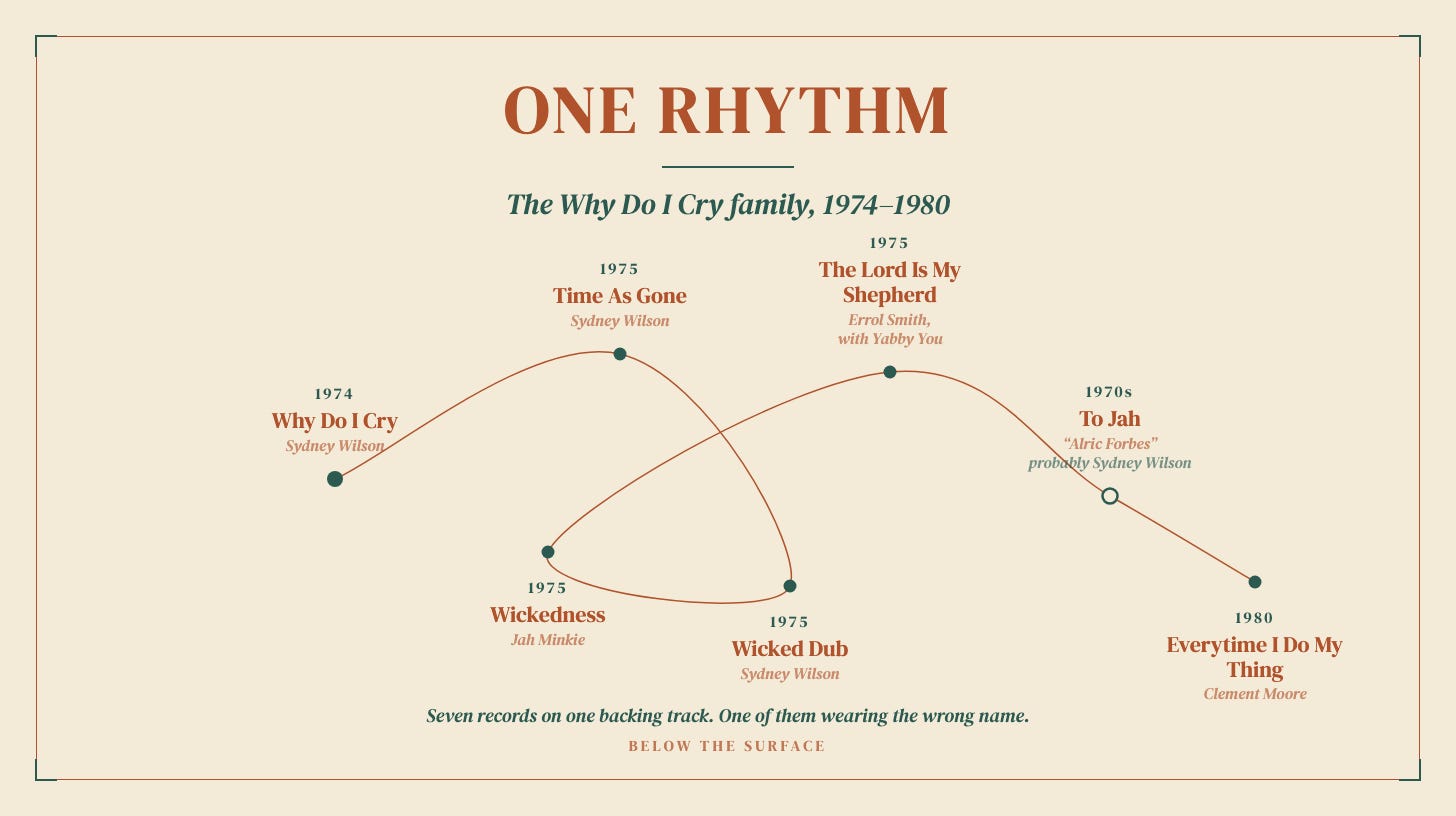
Who is Sydney Wilson? A singer with three records to his name, ever, and all three ride the same rhythm. Why Do I Cry on the Angwal label, Time As Gone on Greek, and a dub called Wicked Dub to close things out. An entire recording career on one backing track, and it’s the rhythm sitting under To Jah. One pressing of Time As Gone even went out on the Rocket label with its title handwritten across a label printed for a different record entirely. In this corner of the catalogue, a wrong label wasn’t even unusual. A singer named Clement Moore rode that rhythm too, on a 45 called Everytime I Do My Thing, the only record he ever made. One-rhythm men, both of them. A whole little community passing a single rhythm around, heard from once or three times and never again.
And Forbes? In 1978 he cut his own vocal of Warn The Nation, the song his own group had made a few years earlier, the title that sits wrongly on my second copy. So the discography now holds a song he definitely sang wearing someone else’s title, and a title he’s credited with that someone else probably sang. I have read that sentence back several times and I believe it is correct.
Deep in the thread
Where does “probably Sydney Wilson” come from? Not from a database. From ears, mostly. From dealer blurbs and comment sections, somebody three replies deep in a thread saying play Why Do I Cry next to it and tell me that’s not the same man. From scratched initials in the dead wax showing that two records passed through the same cutting room. The real archive for this music was never written down. It lives in runout etchings and collector memory, and everyone who gets serious about Jamaican 45s ends up a detective whether they meant to or not.
Even the deepest paperwork keeps the mystery alive. Roots Knotty Roots, a decades-long discography project that has untangled thousands of these knots, catalogues the rhythm under Sydney Wilson’s name and still leaves To Jah credited to Alric Forbes. But the same database holds the detail that makes the whole thing click. A singer named Errol Smith cut a tune called The Lord Is My Shepherd on this rhythm in 1975, and the production credit reads Errol Smith and Vivian Jackson. Yabby You, standing quietly inside Sydney Wilson’s little riddim family. The camp that made Warn The Nation and the camp that made To Jah weren’t strangers. They were neighbours, and between neighbours a swapped label looks less like an accident and more like how business got done.
Man Next Door, from last time, is a lineage you can walk like a paved road. This record is the other end of version culture: no road, no signage, four known copies, a singer nobody can quite confirm. Both are the same tradition. One got remembered by everybody and one got remembered by almost nobody, and the music doesn’t seem to know the difference.
The fix
There’s a French reissue of To Jah now, cleanly pressed, correctly titled, easy to find. I’m glad it exists, because the tune deserves ears. But look closely at what got fixed: the reissue corrects the title and keeps the credit. It still says Alric Forbes. Even the correction carries the mistake.
The original misprint corrects nothing, and I love it for that. Wrong title, disputed singer, no catalogue number, four known copies scattered who knows where. Every fact anyone ever wrote down about this record is somewhere between shaky and false, and the record itself is perfect. Sometimes I'll play my two copies back to back, the honest one and the liar, same label twice, and while they're playing none of it matters.
That seems about right to me. The label was always a suggestion. The music was always the point.
Thanks for reading and listening.